
How to Propose in Paris — From First Step to First Toast
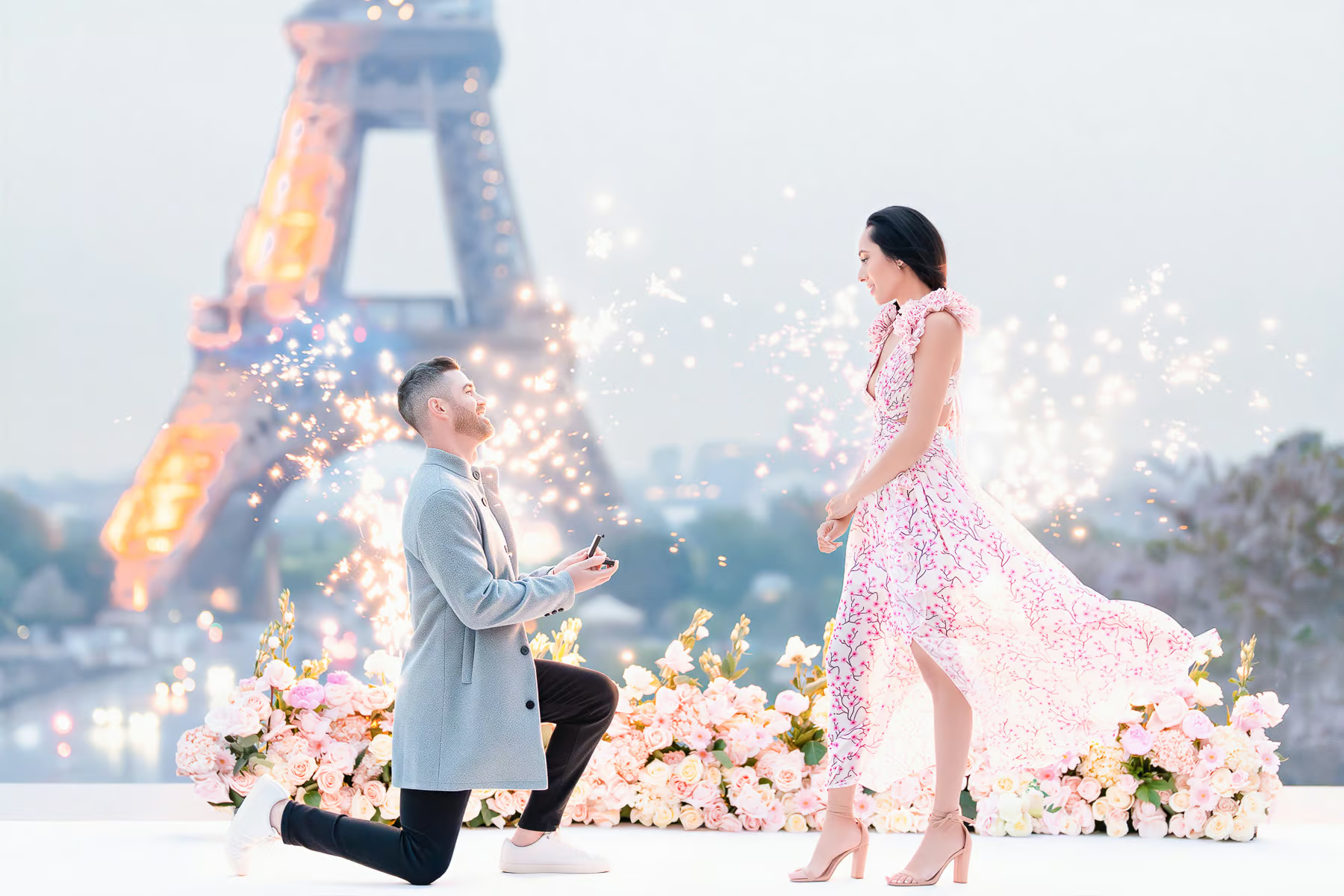

This guide covers the proposal itself: the approach, the speech, the knee drop, the ring exchange, and the first few minutes after she says yes.
There are almost no hard rules. Present an engagement ring. Ask her to marry you. Everything else adapts to you. What follows is not a template. It is built on more than 1,200 proposals and the patterns that consistently work.
The guiding principle is pace. Move with intention in the days before, so nothing is improvised on site. Slow down in the key beats themselves, because a rushed proposal is one she feels less of and the camera catches less of.
Confidence comes from knowing what happens next. Bookmark this page. Come back to it. Make it your own.
On the day, two things should feel right. The proposal should fit who you are as a couple. And it should hold up twice over: strong in photographs decades from now, and fully lived by her as it happens.
Arrival
Proposals typically begin one of two ways: you arrive together, or you are already in place when she arrives.
If you arrive together, the game plan is locked before you walk in. If you arrive first, your Paris proposal photographer has a few minutes alone with you to fine-tune the choreography, show you where to stand, and review the proposal posture that photographs best.
Either version works. Arriving first is the version we prefer when the logistics allow it. There are rare exceptions where she arrives before you, depending on the concept, but those are the 5% we plan around in advance.
The approach
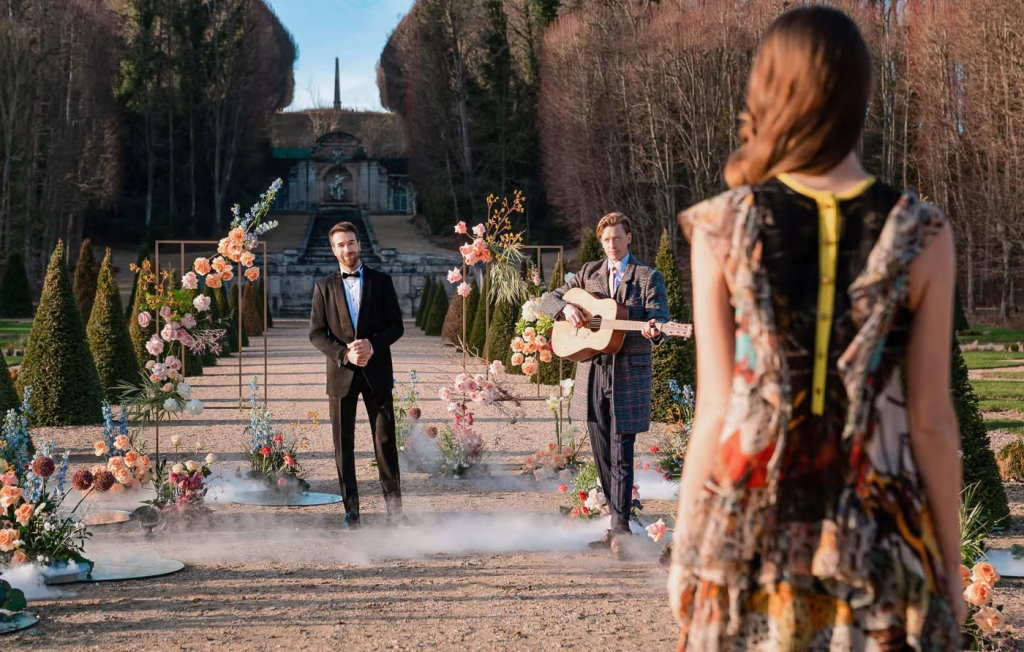
When she arrives after you, step toward her the moment she enters, take her hand, and lead her to the proposal spot.
If you walked in together, you are already hand in hand and will begin the approach side by side.
From here, both scenarios are the same. Halfway down the path, pause briefly and hold her close. Let her take in the setting. Then keep moving.
That pause is worth more than it looks. It settles your nerves. It tells her, without words, that something is about to happen. And it gives her the seconds to appreciate the flowers, the backdrop, and the setting you designed for her before any of it becomes background to the diamond ring.
Positioning
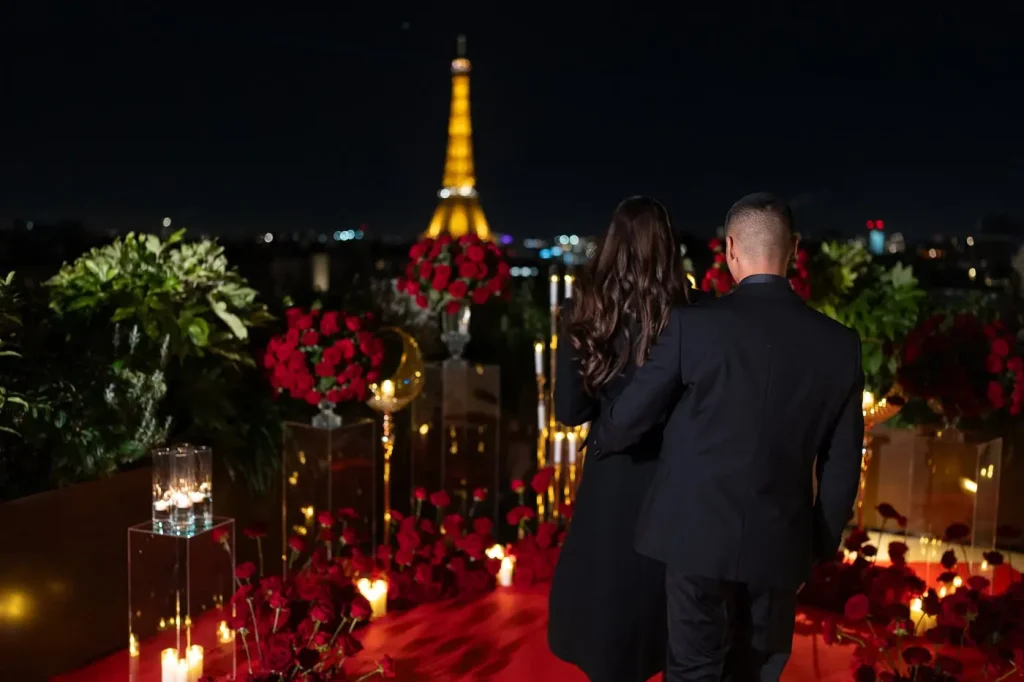
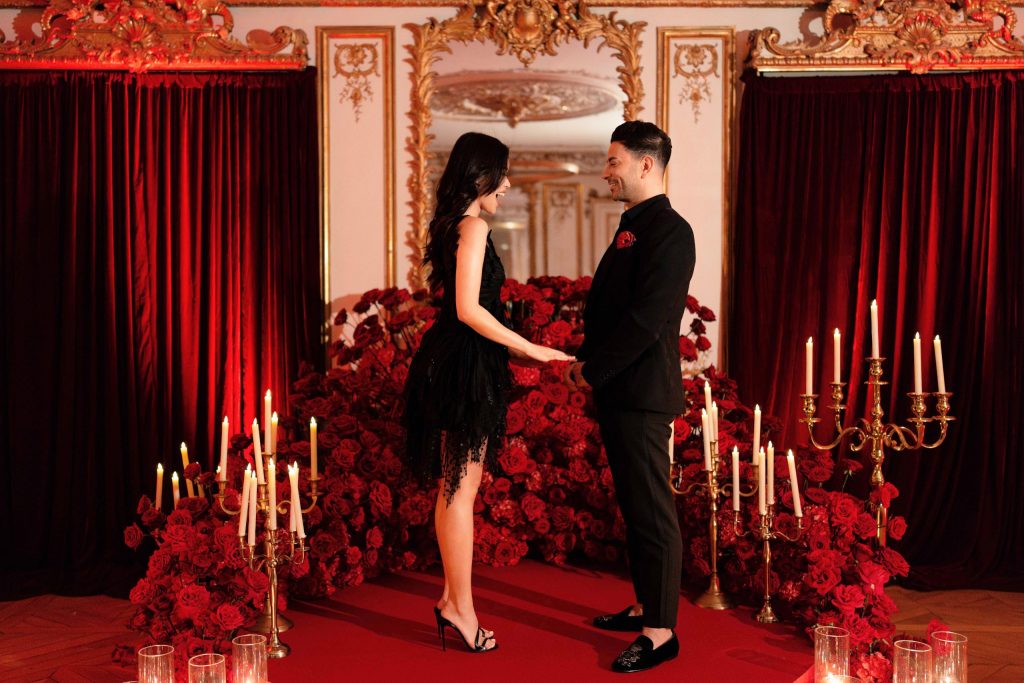
By default, she stands on your right and you on her left, both of you facing the backdrop — château, Eiffel Tower, whatever you chose.
The reason is practical: we want a clean line on the ring exchange when you slide the engagement ring onto her left ring finger — the fourth finger. There is one exception. If she has told you her right facial side is her stronger one, her preference wins and she moves to the left instead.
Either way, stand parallel to the photographer and the backdrop, leave a small space between you, and hold her hands softly as you begin to speak.
The speech
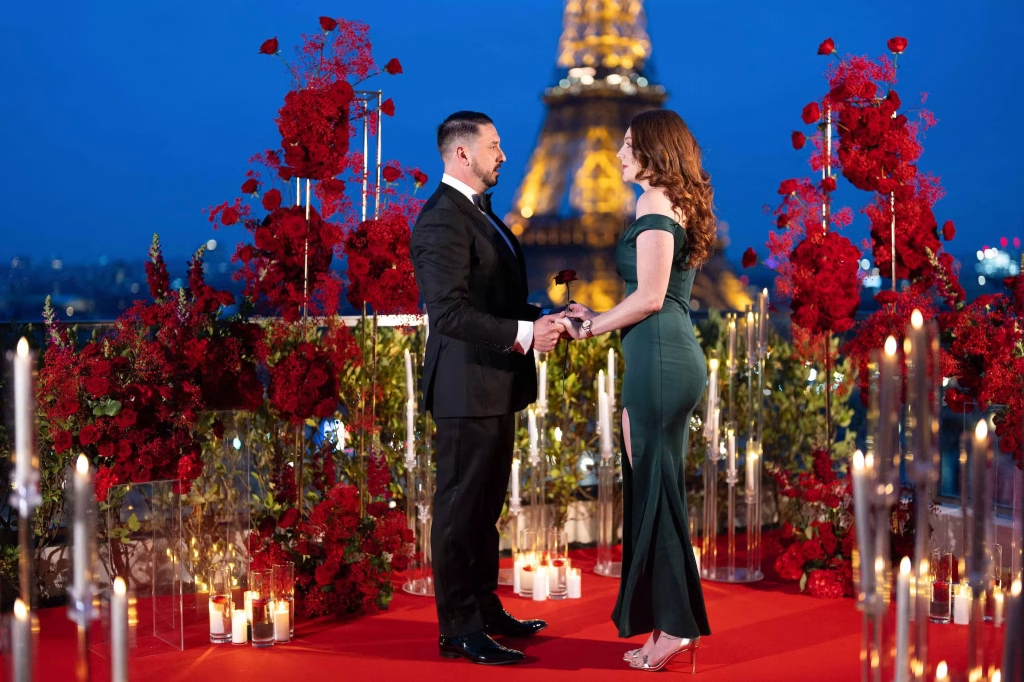
The speech is not the question. The speech comes first. “Will you marry me?” comes later, on one knee, with the open ring box.
This is when you still have her full attention, because once you are on one knee she will be too moved to retain much of anything. Say what sounds like you, in your own words. Polish is nice; sincerity matters more.
A dedicated section on what to say, what to leave out, and how to prepare appears further down the page.
The knee drop
When the speech is done, unbutton your jacket. Take out the ring box, but keep it closed for now. Show it to her. Take a small step back. Then drop to one knee.
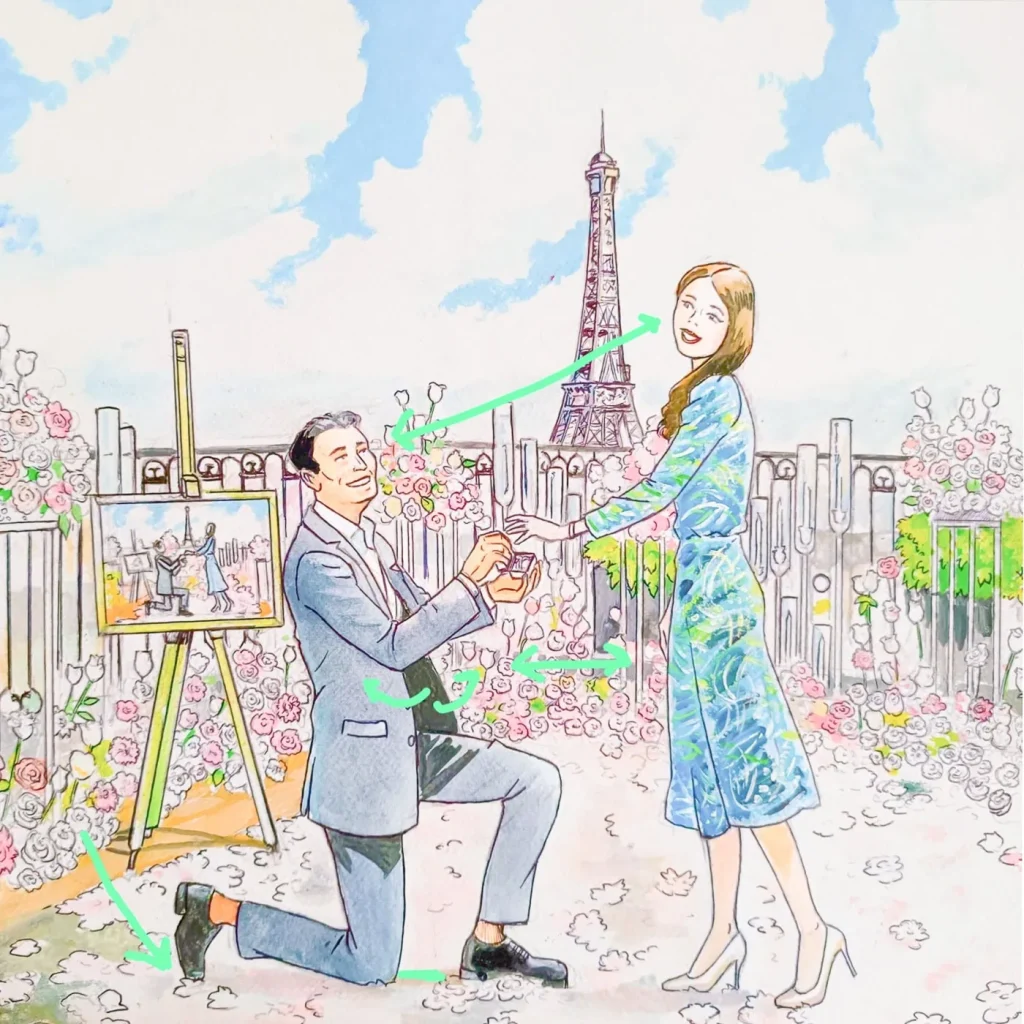
Study the illustration below — every marker points to a detail that affects the photographs.
The posture
The single most important visual detail is your rear foot. The toe should point straight down into the ground, not drag along it.
The posture does not affect the experience itself. It has an outsized effect on the photos. Practice it before the day. This is the Paris proposal posture guide in one sentence — and it is non-negotiable.
Leave a small gap between your back knee and the heel of your front foot. Use whichever knee feels natural. The old rule about kneeling on the left knee like a knight is largely a blog myth and not worth worrying about.
Keep your jacket open as your arms come up to present the ring box — otherwise the lapels bulge and the whole line of the photograph goes with them. Mark the underside of the box with a small indentation so you can feel the correct orientation without looking down.
The four words
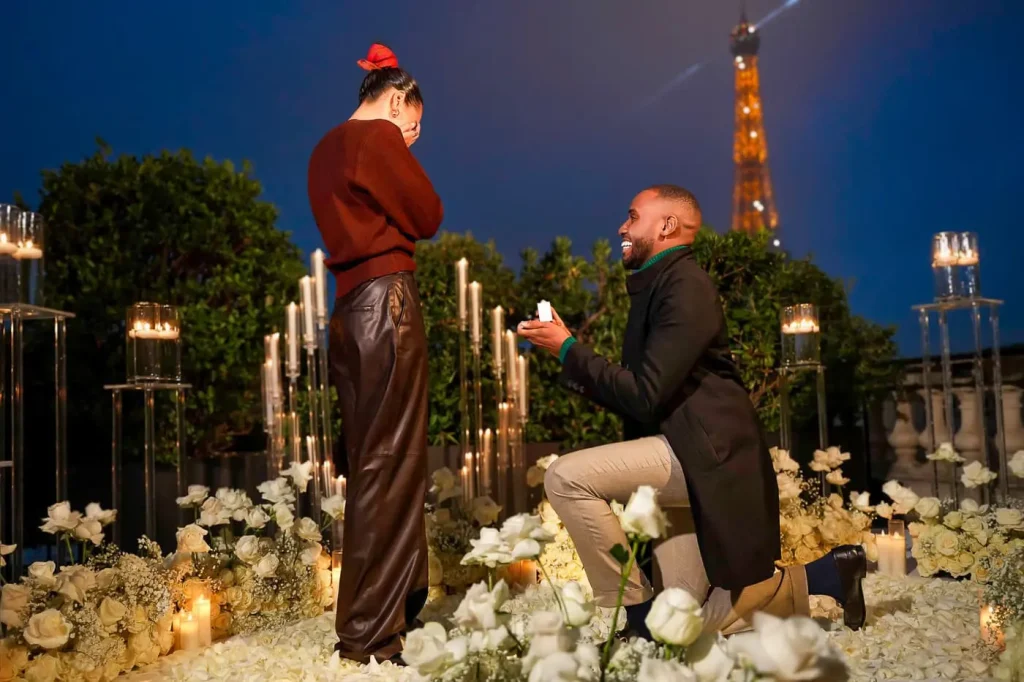
Present the open ring box to her and ask the question: Will you marry me?
Then stop talking. Wait. Stay on your knee for 30 to 45 seconds.
It will feel like an eternity. It is worth it. If she comes down to your level, celebrate — those are some of the most distinctive photos we capture.
The ring exchange
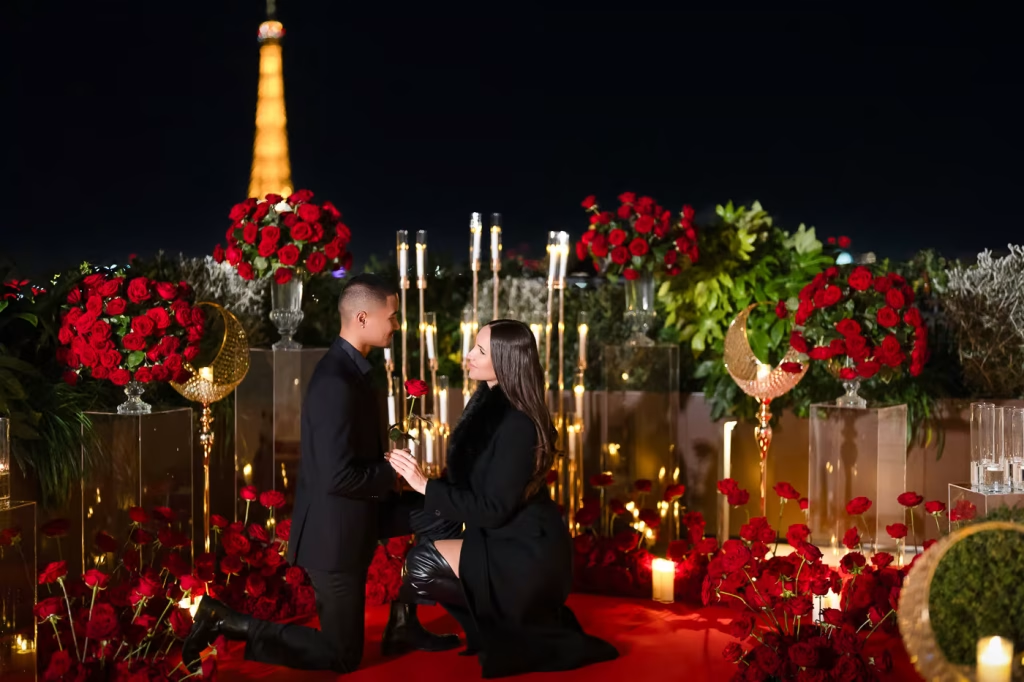
Once she says yes, carefully place the ring box on the floor — flat, stable, open — and only then take the engagement ring out of the box.
Stand up together, returning to how you stood during the speech.
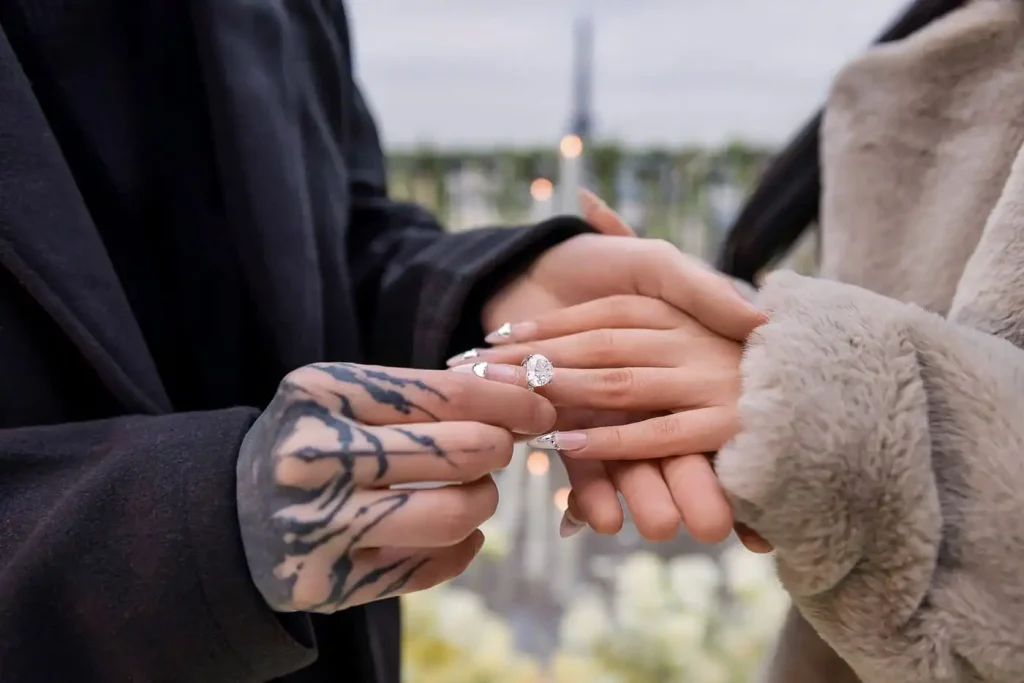
Take her left hand — the one facing the camera — with your left hand underneath, palm up, so her hand rests on top of yours. With your right hand, hold the ring between thumb and index finger, or thumb, index, and middle finger for finer control, and bring it to the knuckle of her fourth finger.
Pause. Look her in the eyes — remember this one. Then slide the ring to the base of her finger.
The first kiss
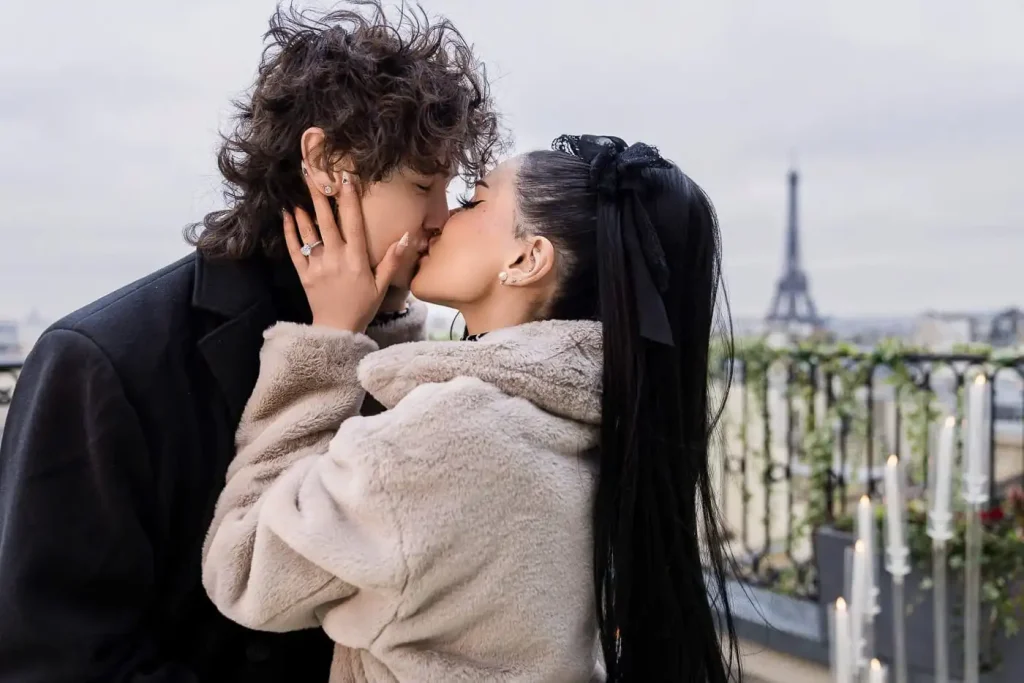
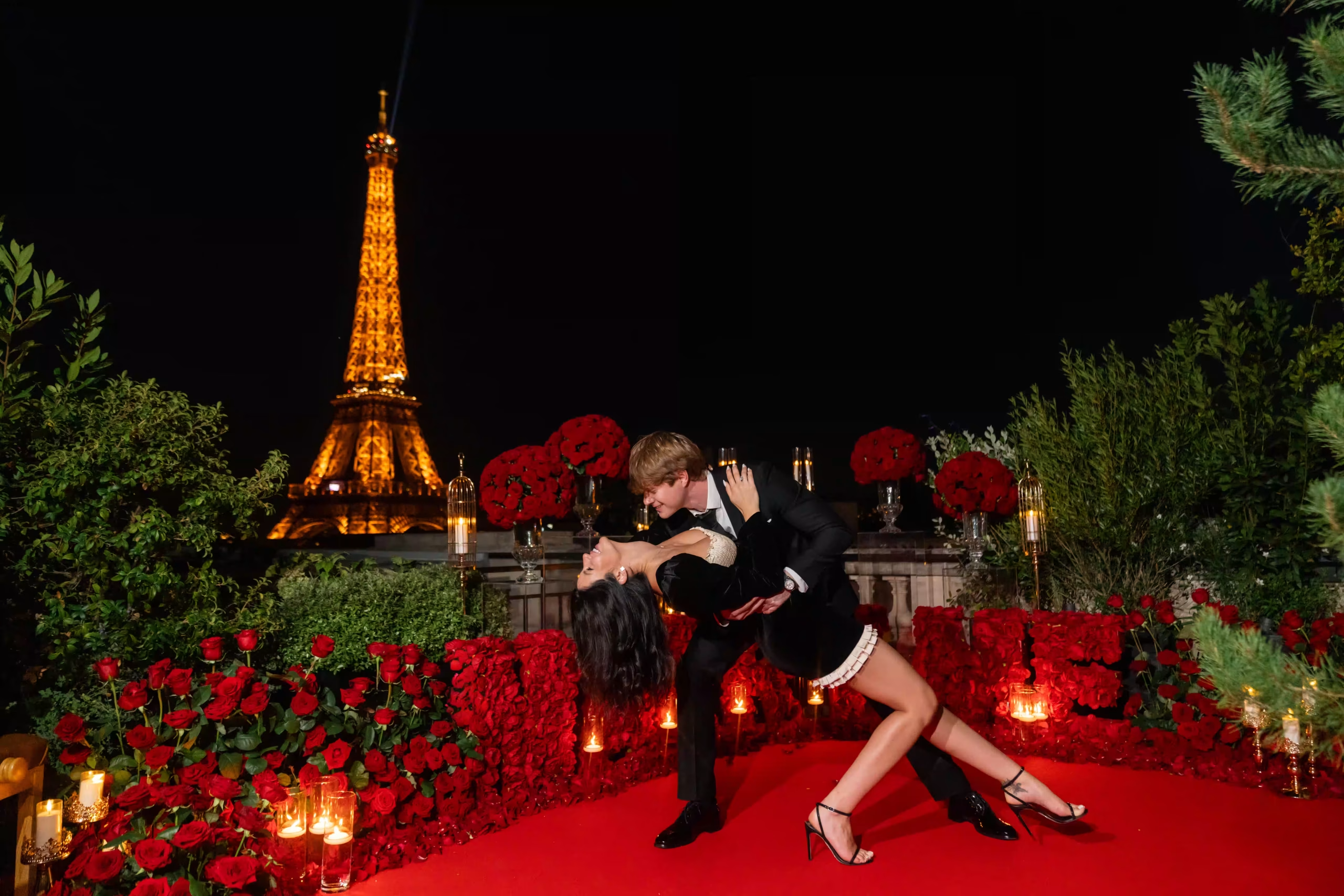
Seal the engagement with a passionate, well-earned first kiss — then do not turn toward the photographer.
Give yourselves several minutes inside the reaction: the tears, the laughter, the questions she will almost certainly start asking. Your photographer is working the whole time, catching all of it from a respectful distance.
This is the part that anchors the gallery. It is also the part you will want back one day, to remember exactly how it felt.
Champagne and the toast
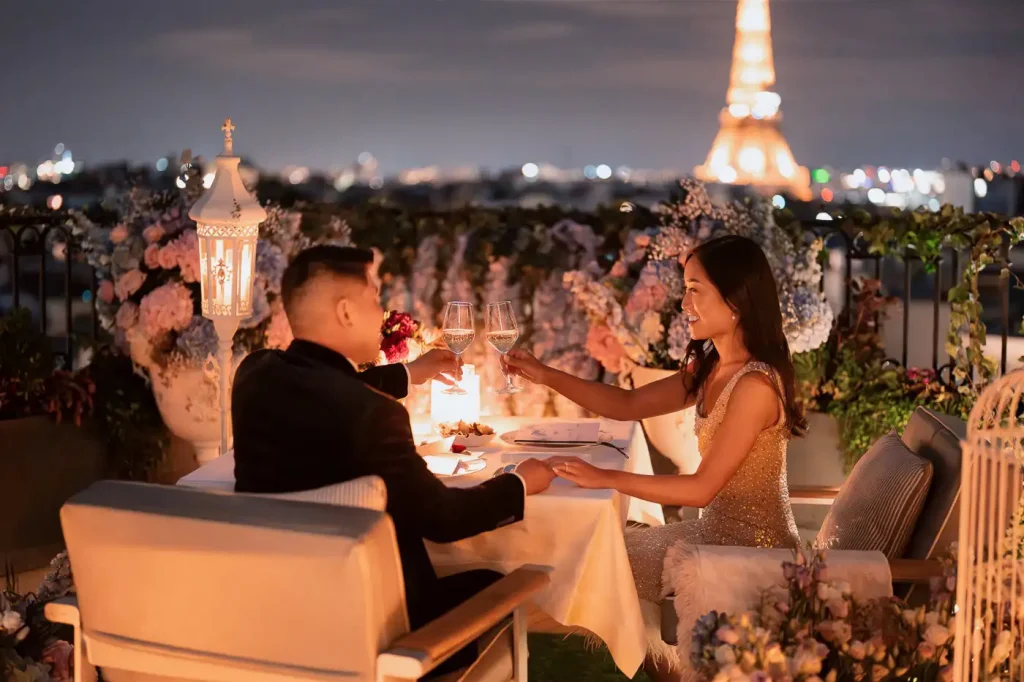
When the artist senses you are ready, they will step in for the first toast with your fiancée.
A champagne pop is optional but encouraged. Request a second, more affordable bottle for the photos and keep the better label for the actual toast. It makes a striking save-the-date image — and the couple always loves the pop itself. Champagne says France and celebration like no other drink.
Keep the toast real. This is not a photoshoot. It is your first toast as an engaged couple. She may even take over and make her own. Take a few more minutes together, and when it feels right, turn away from the camera again.
Then set the flutes down. What comes next is your first portraits as a newly engaged couple in Paris.
The proposal speech, in depth
The speech is the part of the proposal that gentlemen ask about most. Not because it is complicated — it is not — but because it is the part where sincerity meets pressure, and neither comes easily when you are standing in front of her with a ring box in your jacket.
A proposal does not sneak up on you. You know it is coming, and you only get one chance to make this speech. Prepare it.
That does not mean turning it into a performance. It means thinking clearly, ahead of time, about what you want to say, so nerves do not rob the speech of its weight. Even gentlemen who are naturally good with words find that emotion changes things.
What to say. The strongest proposal speeches do three things. They look back briefly at where the relationship began. They say why she matters so deeply. And they look ahead to the life you want to build together.
Simplified to a formula: why you love her, why you want to marry her, and why you want the future to be with her.
Keep it personal. Keep it specific. Keep it in your own voice.
What not to say. A full inventory of every trip. Inside jokes that need explaining. Anything that sounds written for the photographer rather than for her.
On spontaneity. Leave room for it in the delivery, not in the drafting. The speech itself should not be improvised on the spot. This is too important, and the one chance you get matters too much. The goal is not to sound rehearsed. It is to make sure the words that matter come out.
On reading it. Some gentlemen memorize. Some carry a small card with bullet points. Some read a fully written speech. All three are fine. The woman standing in front of you is the last person in the world who will judge you for caring enough to prepare.
Some gentlemen also work a sequence of handwritten messages or photographs into the proposal itself, walking her through memory lane before popping the question.
One last thing. Rehearse the speech out loud, alone. What feels right in your head can sound different when you say it.
There is no single right format. But there is one wrong one: treating the speech casually, and hoping the words will just follow.
Frequently asked questions
What do you say when you propose?
Say why you love her, why you want to marry her, and why you want the future to be with her. Those three things, in your own words. Polish is optional. Sincerity and effort are not.
How long should a proposal speech be?
Anywhere from 30 seconds to two minutes, with one minute as a sweet spot. Under 30 seconds can feel rushed. Over three minutes, she starts wondering when the question is coming. The length matters less than the substance — a short speech trumps a long one that wanders.
Do you have to get down on one knee to propose?
Not necessarily. A standing proposal or a seated proposal can work. The knee drop is a traditional sign of chivalry and a visual cue that photographs powerfully, but the engagement exists the moment she says yes. If kneeling is not for you, or unusual in your culture, do not force it.
Which knee should you propose on?
Either knee works. The tradition of kneeling on the left knee is a chivalry myth from a different era. Your choice should be guided by stability, the perfect posture in the photographs, and what feels natural to you. Choose the knee that lets you balance cleanly, point your rear toe straight down, and hold the ring box steady.
How do you keep a Paris proposal a surprise?
Plan the logistics weeks in advance so you are not improvising on the day. Keep the ring box out of your main luggage and stash it somewhere she would not think to look. Act like yourself the morning of. When a proposal surprise fails, it is usually not because of the logistics. It is because you start behaving unusually, and she notices.
How much does a Paris proposal cost?
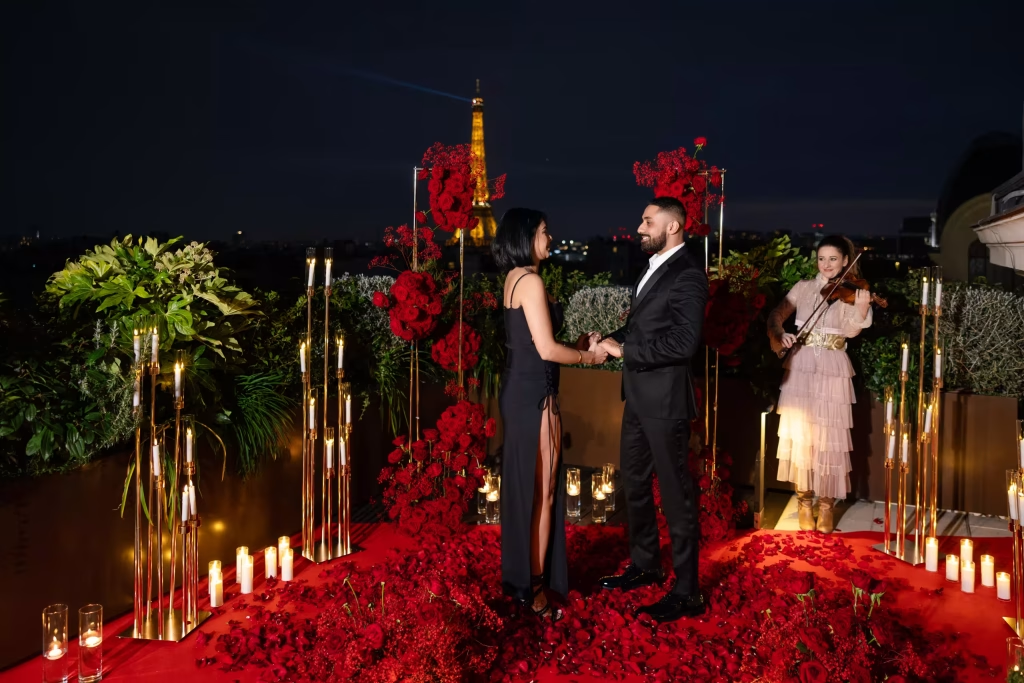
Proposal budgets span the spectrum. A photographer-led proposal at a public Paris landmark, such as Trocadéro, can start around €300. A luxury production with Chantelle Streete as your full-service proposal planner — private venue, custom florals, live musicians, drone capture, fireworks, rare champagne, luxury transport, and a private fine-dining experience afterward — adds up into the tens of thousands and can exceed six figures.
The price lives in the variables: the venue itself, whether that is a public spot, an Eiffel Tower rooftop terrace, a château, or a yacht; the scale of the floral design and whether the blooms are fresh or silk; the quality and reputation of your photographer and videographer; whether you add drone coverage or fireworks; the dinner format, from restaurant booking to private Michelin-starred dining with a butler; transport, from Rolls-Royce to horse-drawn carriage, helicopter, or yacht; and whether you stay where you propose or continue on to one of Paris’s luxury hotels, such as the Ritz, Le Bristol, La Réserve, Saint James, or Costes.
Our planning fee also depends on complexity — a single-venue proposal is simpler than a multi-location discovery quest with performers and surprises across several Paris landmarks.
Most couples we work with spend between €7,000 and €30,000. Some choose to go significantly beyond. What matters most is not the number itself but whether the production exceeds your lofty expectations and matches what you want her to remember.
Ready to write the next chapter
in your love story?
Let’s work together!