
On this page
PARIS · A PHOTOGRAPHER’S LOCATION GUIDE
Best Photo Spots in Paris
Find your view, your light, and the Paris you want in your photographs.
Start with the photographs you want.
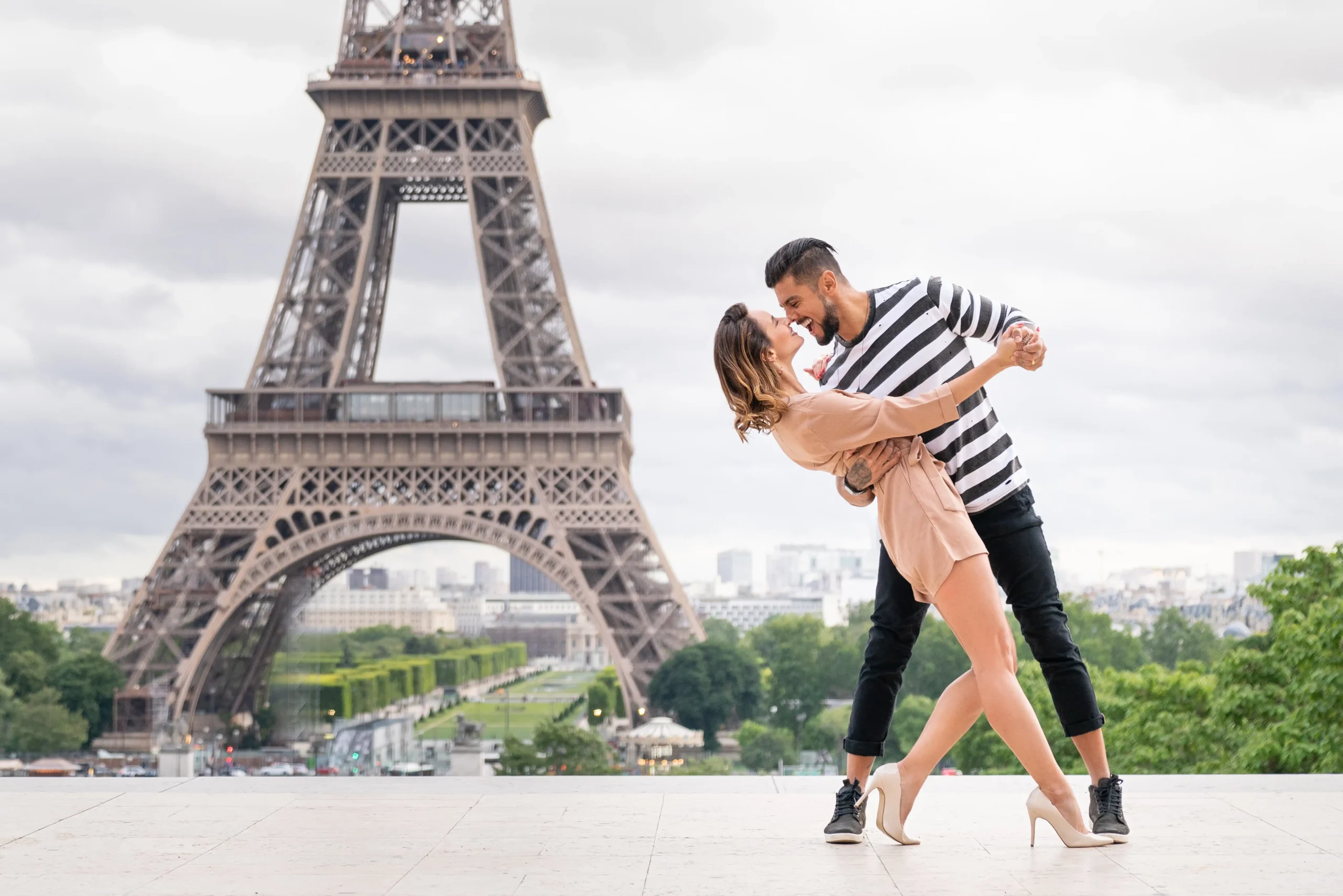
For the full Eiffel Tower, start at Trocadéro. For iron columns and river views, choose Bir-Hakeim. The Louvre brings palace stone and the glass pyramid; Montmartre gives you café fronts and hillside streets. For playful architecture, try Palais-Royal; for a garden setting, Luxembourg.
Compare eight main areas and 26 mapped settings using the places our photographers know from working in Paris. You’ll find photo examples, timing, walking notes and access checks for couple portraits, solo photographs or pictures of your own.
Where to take photos in Paris: choose your look
Compare the backgrounds below, then plan the route with your photographer around your priorities and session length.
| You want | Start here | The photographs | The tradeoff |
|---|---|---|---|
| Iconic Eiffel Tower views | Trocadéro or Bir-Hakeim | Frontal terraces or iron columns | Popular settings; people share the space |
| Several looks in one area | Louvre & Tuileries, Palais-Royal | Pyramid, palace stone, garden or arcades | Opening times and professional access matter |
| Romantic neighborhood portraits | Montmartre or Notre-Dame & the Seine | Café fronts, side streets, river views | Slopes in Montmartre; changing works around Notre-Dame |
| Dressed-up or editorial photographs | Alexandre III & Petit Palais, Place Vendôme | Ornate details, formal façades, a golden entrance | Traffic and managed entrances |
| Playful photographs | Palais-Royal or Trocadéro stairs | Graphic columns, movement and changing levels | Work within the space available |
| A recognizable café setting | La Maison Rose, Le Consulat, Café de Flore | Pink façade, corner café or boulevard terrace | Working businesses; ask staff |
| Gardens and softer backgrounds | Luxembourg or Tuileries terrace | Trees, benches, fountain and garden paths | Seasonal opening hours; shoot permissions |
| One bold photograph after dark | Moulin Rouge or Pont Alexandre III | Neon or illuminated lamps beside the river | Moulin Rouge has limited variety |
Paris photo spots map: find what belongs together
Explore the main areas and their named backdrops. The list and each map pin lead to the same location description.
The location list works without loading the map.
Trocadéro
Bir-Hakeim & Île aux Cygnes
Louvre & Tuileries terrace
Palais-Royal
Pont Alexandre III & Petit Palais
Notre-Dame & the Seine
Montmartre
Luxembourg Gardens
Smaller stops
Explore the photo locations.
Choose a name or a numbered pin. See the photographic character, access note, directions and a link to the full description.
26 settings across eight main areas and smaller stops. Pins identify viewpoints, terraces or streets. Use directions to check your approach, and agree the meeting point and any required permissions separately with your photographer.
Best Eiffel Tower photo spots: compare the views
Trocadéro makes the Tower the subject. Bir-Hakeim adds structure and strong lines. Alexandre III lets it sit quietly in the distance. Decide how much of the Tower you want before choosing the nearest-looking pin.
| Setting | What changes in the photograph | How to think about it |
|---|---|---|
| Trocadéro | The full Tower, seen frontally across the river | Main area: terraces, stairs and gardens |
| Bir-Hakeim | Tower framed by ironwork or seen beside the bridge | Main area with a partly sheltered walkway |
| Pont d’Iéna | A closer Tower composition at the crossing | A specific viewpoint below Trocadéro |
| Avenue de Camoëns | Residential façades and a stone balustrade | Small backdrop; current arranged-shoot restrictions |
| Rue de l’Université | Street architecture framing the Tower’s base | Opposite bank; restricted dead-end section |
| Passerelle Debilly | Tower and river from a pedestrian bridge | A narrow crossing, rather than a whole neighborhood |
| Pont Alexandre III | A smaller, distant Tower with ornate bridge details | Its own area farther east |
Before your session, confirm the route, current access and any photography permissions with your photographer.
01 / MAIN AREA
Trocadéro: full Eiffel Tower views, terraces and stairs
Choose Trocadéro when you want Paris to be unmistakable. The Tower sits across the river, with terraces and stairs that change the composition without taking you to another neighborhood.
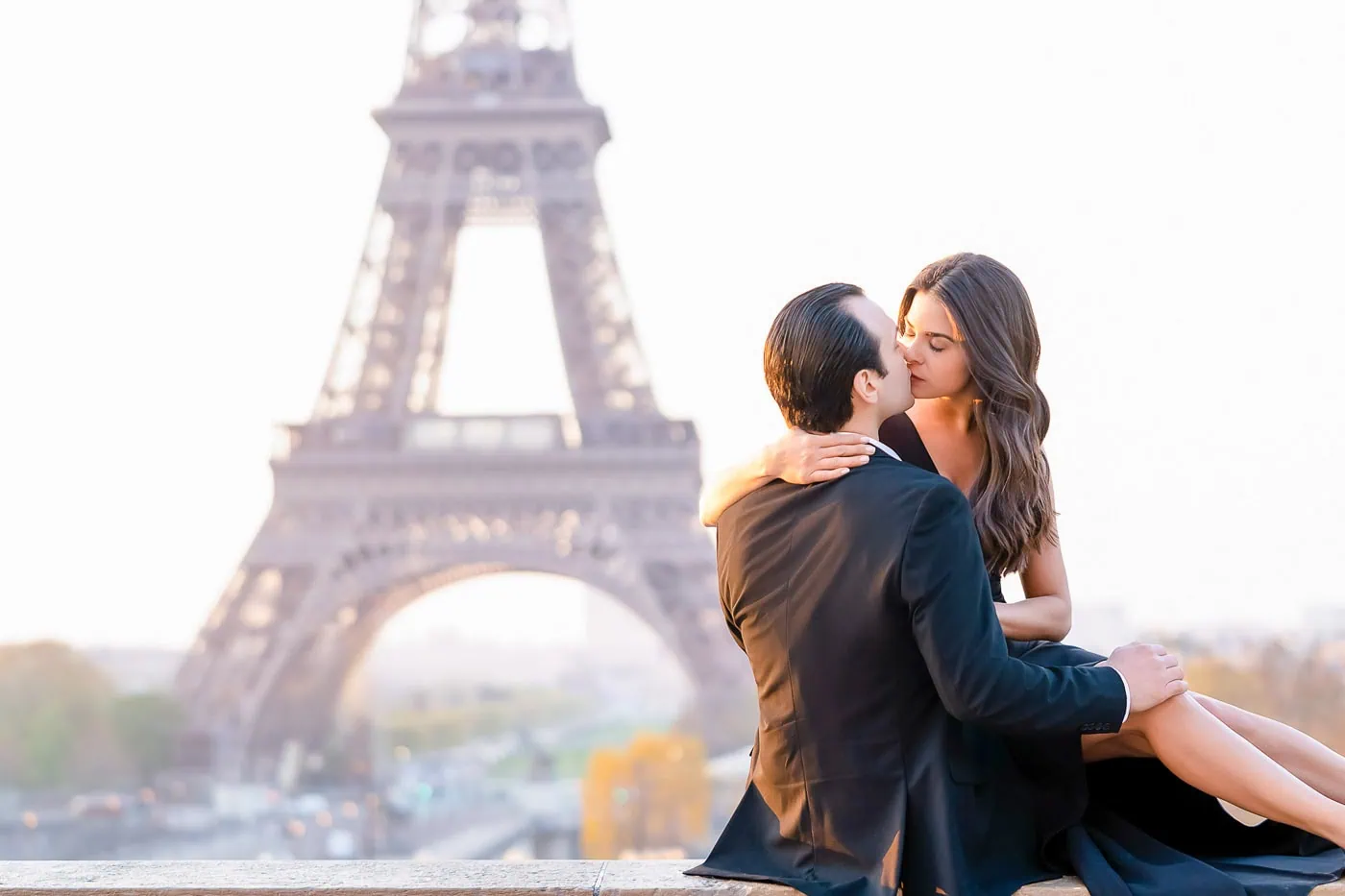
The upper esplanade gives you the familiar frontal view. Move toward the stairs and lower terraces for leading lines, greenery or a closer relationship between you and the Tower. Those changes give Trocadéro enough variety for a substantial set of photographs.
Sunrise often gives the best combination of early light and fewer people. Arrive before it if you like silhouettes against the brightening sky. Cloud and season change the result; a fixed 5:45 a.m. meeting time would make little sense in winter. Later photographs are possible, with a busier public space around you.
Best conditions Early light for the classic view; expect more activity later.
Underfoot Stone terraces and stairs between levels. Plan an approach that suits your mobility.
Access Installations, events and temporary restrictions can change the platforms available.
Choose another area if You want café streets or architecture without a landmark dominating the frame.
The upper esplanade
The broad, frontal view between the Palais de Chaillot’s wings. Use it when the whole Tower matters more than neighborhood detail. It is a popular public place, even early.
Gardens, stairs & fountains
The descent introduces different levels, paths and garden perspectives. Stay out of the fountain basins and keep belongings close; a beautiful background still needs your attention.
Pont d’Iéna
A closer Tower view at the river crossing below the gardens. Use the pedestrian side and keep the walkway clear.
02 / MAIN AREA
Bir-Hakeim Bridge & Île aux Cygnes: columns and river views
Come for the repeating ironwork; stay for the change of scenery beside the water. Bir-Hakeim gives Eiffel Tower portraits a different rhythm from the open terraces at Trocadéro.

The central walkway beneath the Métro viaduct creates long lines and repeating frames. Beside the bridge, the Tower is more open to view. The island path below changes the photographs again, with trees and the Seine replacing much of the ironwork.
Early portraits can be easier to organize around fewer people. After dark, the lamps give the bridge a distinct atmosphere. The overhead structure offers partial shelter, but wind and rain still reach the walkway. The island is outdoors, and the bridge remains a place people use to get somewhere.
Best conditions Early light or the transition into evening, depending on the look you prefer.
Underfoot Shared walkways; stairs lead to the island. Watch for cyclists and other people moving through.
Access The City asks arranged shoots to contact Mission Cinéma before planning at Bir-Hakeim.
Pairs with Other nearby river perspectives, rather than an automatic transfer to the Louvre.
The central walkway
Promenade Jean-Paul-Belmondo is the repeating-column setting beneath the viaduct. Discuss whether you want the symmetry itself or the Eiffel Tower visible through the structure; those are different camera positions.
Île aux Cygnes
The narrow island walk offers trees and water as a change from the bridge. Its access and length deserve consideration before adding it for someone who finds stairs or longer walks difficult.
03 / MAIN AREA
Louvre & Tuileries photo spots: pyramid, courtyards and terrace
Choose this part of Paris for architecture and variety: glass against carved stone, an enclosed palace courtyard, and a tree-lined terrace beside the Seine.
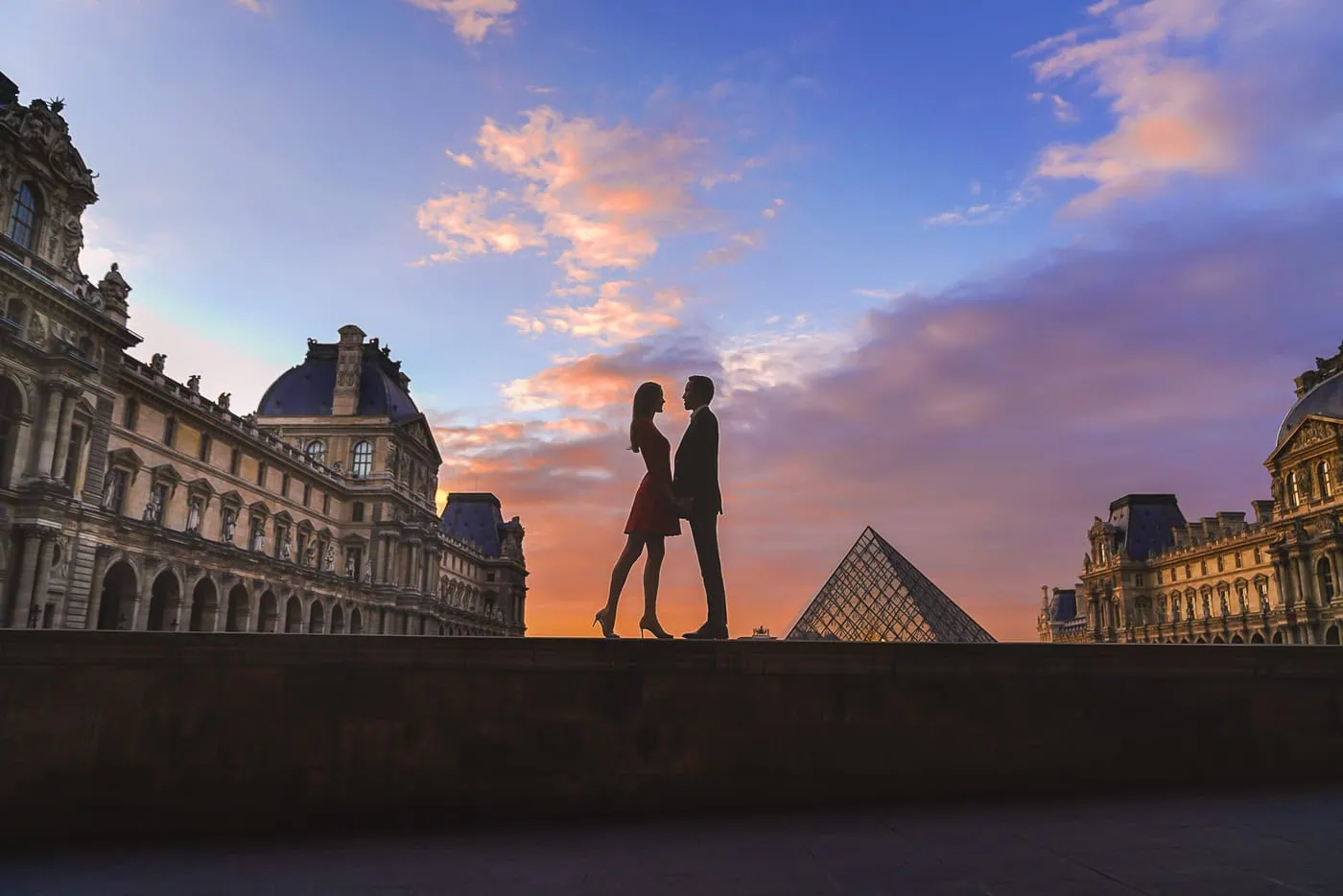
The pyramid is only one part of the choice. The Cour Napoléon gives you the contrast of glass and palace façades; the Cour Carrée is about stone, symmetry and an enclosed space. Framing from beside the passage between them can reduce how much of the busy courtyard appears behind you, without needing the whole Louvre to be empty.
For garden photographs, we favor the elevated Seine-side Tuileries terrace, the Terrasse du Bord-de-l’Eau. Its trees, benches and views toward the Louvre add a softer setting. We avoid building commissioned portraits around the main gardens because interruptions from guards are more common there. The terrace is still part of the Louvre domain and follows its rules.
Light Early light or the change toward blue hour; access may exclude summer sunrise or late sunset.
Published hours Cour Napoléon: 7:30 a.m.–9 p.m. Cour Carrée: 7:30 a.m.–7:45 p.m. Check current hours and notices.
Professional access The Louvre’s 2024 rules require prior written authorization for professional photography in the domain.
Pairs with Palais-Royal or Pont des Arts, with time left for photographs between stops.
Pyramid / Cour Napoléon
Choose glass, water reflections where conditions allow, and the surrounding palace façades. Evening illumination is appealing, but “after the museum closes” is not the same as unrestricted courtyard access.
Cour Carrée
A different photograph without the pyramid: four sides of carved palace stone, strong geometry and a more enclosed feeling. Check its earlier published closing time before planning an evening visit.
Tuileries Seine-side terrace
The raised terrace runs along the Seine side of the garden. Choose it for tree-lined perspective and garden portraits, not as a way around permission requirements. Its opening hours are seasonal.

04 / MAIN AREA
Palais-Royal: Buren columns, arcades and garden portraits
Palais-Royal is a strong choice when you want changing backgrounds in a relatively compact setting. Graphic stripes and classical architecture sit close together.

The columns suit movement and playful compositions. The surrounding façades and arcades give you straighter lines and a more restrained portrait. Beyond them, the garden adds trees, benches and a fountain. These contrasting settings sit within one compact area.
Start after the domain opens at 8 a.m. Morning can be pleasant before the day gathers pace; later activity can also belong in the photographs. The arcades offer some cover and remain shared passageways.
Opening 8 a.m.–10:30 p.m., April–September; 8 a.m.–8:30 p.m., October–March. Check the domain’s hours.
Underfoot Stone paving and garden paths. Check your intended entrance if steps are an issue.
Professional access Ask the Centre des monuments nationaux about arrangements for your shoot.
Choose another area if Your first priority is a prominent Eiffel Tower view.
The Buren columns
Les Deux Plateaux is the black-and-white column setting in the Cour d’honneur. The varied heights create depth; you can make playful photographs around them without treating the artwork as a climbing course.
Garden & arcades
The garden and galleries change both the background and the pace. Think benches, lines of trees and sheltered architectural frames, with room left for visitors using the paths.
05 / MAIN AREA
Pont Alexandre III & Petit Palais: ornate lamps and golden gates
Choose this area for ornate lamps, pale stone, gilded details and river views, with the Eiffel Tower as a smaller part of the skyline.

The bridge rewards a more dressed-up portrait, but it also gives you enough detail and changing perspectives for photographs that feel less formal. Its approaches and the river below offer alternatives to standing in the same place for every frame. Reaching a lower quay adds stairs and a different access question.
Petit Palais adds a golden entrance and monumental façade. Choose an appropriate exterior viewpoint and confirm access before using the museum’s entrance or steps. Early light and the change into evening both suit the bridge; traffic, pedestrians and events influence the experience.
Light Early light, late light or illuminated lamps after dark. These create different photographs.
Underfoot Bridge pavements share an active road; lower river viewpoints may involve stairs.
Petit Palais The museum’s shoot policy requires authorization in its controlled spaces and excludes shoots for private individuals. Check any proposed entrance or step position.
Pairs with The bridge and exterior palace setting, with time to move between them.
The bridge & river views
Choose lamps and gilded ornament for a formal frame, or turn toward the Seine for a more open background. A distant Tower view belongs in this comparison, but this is not the Trocadéro neighborhood.
Petit Palais exterior
The golden gate and carved entrance are the attraction. Frame from an appropriate public position and keep entrances clear; a photograph of the façade does not grant access to the museum’s steps or interior.
06 / MAIN AREA
Notre-Dame & the Seine: cathedral views and café streets
This is a main area for people who want more than one kind of Paris: cathedral stone, water, bridges, a bookshop front and a colorful restaurant street.

Choose your cathedral view first: the front, side and opposite-bank perspectives each catch different light. Then add the river or a nearby street for a change of scale and color. Current works can affect the frame.
Shakespeare and Company and Au Vieux Paris d’Arcole offer very different storefronts. Île Saint-Louis can extend a neighborhood walk; allow a separate transfer if you also want the Louvre. Work around Notre-Dame’s surroundings continues to change access and available backgrounds.
Light Consider afternoon light for the cathedral’s west front. For a river portrait, choose the bank and the view first; the light changes with season and position.
Underfoot Quays, uneven paving, bridges and possible stairs to the lower riverbanks.
Access Check the current works around the cathedral and the exact river approach you intend to use.
Choose another area if The Eiffel Tower has to be the main background.
Cathedral from the Left Bank
The river creates separation between you and the cathedral. The map marks the riverside area; choose the available camera position and cathedral angle on the day.
Shakespeare and Company
The bookshop’s green frontage and neighboring café give the photographs a recognizable street setting. Keep the door clear and ask before planning portraits that use the business’s space.
Au Vieux Paris d’Arcole
Color, a distinctive façade and seasonal flowers on Rue Chanoinesse. The planting changes through the year. Ask staff before using a table or terrace for portraits.
07 / MAIN AREA
Montmartre photo spots: La Maison Rose, Le Consulat and Sacré-Cœur
Choose Montmartre for the variety between places: a basilica above the city, winding streets, café fronts and steps. The walk is part of the appeal.

Montmartre offers La Maison Rose, Le Consulat, the painters and cafés of Place du Tertre, and views from the terraces below Sacré-Cœur. Sunrise is quieter; later, the cafés and street activity become part of the photographs.
Morning often makes the busiest named backdrops easier to use. Later, café activity and illuminated streets give the area another character. Moulin Rouge sits lower down toward Boulevard de Clichy: plan it as a separate stop for a lively boulevard and neon.
Underfoot Slopes, steps and cobblestones. Plan the actual route if walking is difficult.
For an arranged shoot The City’s production restrictions include the Montmartre–Sacré-Cœur perimeter. Check current restrictions and confirm how they apply to your session.
Café etiquette Ask staff, leave doorways clear and give customers their space.
Choose another area if You need level walking or want the Eiffel Tower to dominate the photographs.
Sacré-Cœur exterior & steps
The basilica, terraces and city panorama give you the larger view. Parts of the approach involve considerable stairs, so choose your arrival point before deciding where to begin.
La Maison Rose / Rue de l’Abreuvoir
The pink restaurant and curving street make a recognizable backdrop. Step back for the street perspective; a close portrait at the façade tells a different story. It is a working restaurant in a lived-in neighborhood.
Le Consulat
The corner café has a different silhouette from Maison Rose, with intersecting streets adding depth around it. Make it a stop on your neighborhood walk, leaving space for people coming through the café.

08 / MAIN AREA
Luxembourg Gardens: Medici Fountain and tree-lined paths
Choose Luxembourg for the Medici Fountain, tree-lined paths and palace backdrop. Give the garden its own place in your visit, with time to enjoy the different settings.

The fountain has a more intimate scale than the broad palace-facing garden. Paths, rows of trees and the familiar green chairs add other possibilities within the same visit. Choose Luxembourg if those softer backgrounds appeal more than moving between several monuments. For a family session with children, allow time for a walk and a break between portraits.
The Senate publishes seasonal opening hours in half-month periods, starting on the 1st and 16th; clock changes can create an extra adjustment. Early summer sunrise comes before the gates open. Check the schedule for your exact date and arrange the Senate’s required authorization for professional photography.
When to go Check the published opening hours for your exact date before choosing the light.
Underfoot Garden paths and changes of level. Check the intended gate and fountain approach.
Professional access The garden’s official guidance requires authorization for professional photography. Keep off the lawns.
Choose another area if You need a flexible after-dark setting or a prominent Eiffel Tower view.
Medici Fountain & the surrounding garden
The long basin, trees and sculpted end create a strong single setting. Add garden paths or palace-facing perspectives for variety, leaving the fountain’s shared visitor space clear.
More Paris photo spots: cafés, bridges and after-dark stops
A small stop can be the favorite photograph of the trip. It simply needs a different place in the plan from a whole neighborhood.
Avenue de Camoëns
The stone balustrade and residential architecture frame the Eiffel Tower in a much smaller setting than Trocadéro. Choose it for that particular look, not for extensive variety. The stairs and small footprint matter. The City currently restricts arranged shoots here; do not build a commissioned session around it without clearance.
Rue de l’Université, at the Eiffel Tower end
Choose this street for façades framing the Tower’s base. It is a long street: the setting people mean is near Avenue de la Bourdonnais, not the street’s center. The dead-end section beyond that avenue is on the City’s restricted-shoot list. It is across the river from Trocadéro.
Passerelle Debilly
A pedestrian crossing for a Tower-and-river photograph. It offers a particular view with less background variety than a main area. Leave room for people crossing and check access before making it essential. It sits between the Trocadéro and Alma river stretches, not beside Pont Alexandre III.
Pont des Arts

Choose open river views, wooden decking and the Institut de France at one end. It pairs geographically with the Louvre or a walk toward Saint-Germain. Morning can be quieter; evening brings people lingering over the river. Leave space for other walkers.
Moulin Rouge after dark

The red windmill and neon are the whole reason to come. Expect limited variety and a lively boulevard with a different atmosphere from the Montmartre hilltop. Blue hour and nighttime make more of the lights. Treat it as a separate finale, with time for the descent and the photographs.
Place Vendôme
Pale façades and formal proportions suit fashion-led portraits. Choose it when the architecture appeals to you or when you are already exploring this part of central Paris. Hotel entrances, cars and people remain part of the square. A single strong look is a good enough reason to stop.
Café de Flore & a Saint-Germain café stop
For some people, a café table says more about the trip than another landmark. Café de Flore is one recognizable choice. Ask staff before arranging portraits, order something, and give other customers their space. Agree any photography arrangements separately from a table reservation.
Best time to take photos in Paris: by location
Sunrise usually brings softer light and fewer people; evening offers blue hour and illuminated landmarks. Gardens and courtyards depend on opening hours.
| Location | When it works | What to check |
|---|---|---|
| Trocadéro | Early morning for softer light; later for livelier terraces. | Crowds and events vary. Check current esplanade access. |
| Bir-Hakeim | Daylight for the columns; especially blue hour for the illuminated Eiffel Tower. | Shared walking and cycle routes. Confirm arrangements for a commissioned shoot. |
| Louvre | Day and evening for varied palace and courtyard photographs; especially blue hour around the pyramid. | Confirm courtyard access and photography permissions. |
| Tuileries terrace | Daylight within the garden’s opening hours. | Check seasonal hours and garden access. |
| Palais-Royal | Early after opening for quieter columns, arcades and garden paths. | Confirm current opening hours and professional access. |
| Pont Alexandre III | Day and night, especially sunrise and blue hour; rain can add reflections. | Traffic, pedestrians and access to the lower quays. |
| Notre-Dame & the Seine | Sunrise and soft light for cathedral and riverside portraits. | Current works, river conditions and the precise cathedral view. |
| Montmartre | Sunrise for quieter streets; day and evening for lively cafés and neighborhood scenes. | Slopes, steps and working businesses. Check arrangements for commissioned photography. |
| Luxembourg Gardens | Daylight within the garden’s opening hours. | Check current hours. Professional photography requires authorization. |
| Moulin Rouge | Blue hour and night bring out the red windmill and neon. | A lively boulevard and limited pavement space. |
Overcast skies can also be flattering for portraits. Check sunrise and sunset for your travel dates: early summer sunrise can come before gardens open, and blue hour can fall after a courtyard closes.
For commissioned photography, check the location’s access notes and permission requirements as well as opening hours.
Tuileries terrace hours: the current Louvre visitor page lists 7 a.m.–9 p.m. in April, May, September and October; 7:30 a.m.–7:30 p.m. in November–March; and 7 a.m.–11 p.m. in June–August. The garden begins clearing 30 minutes before closing. Check live hours and entry notices.
Keep your shortlist geographic: stay within one main area for variety, or add a specific nearby backdrop. A drive to Montmartre is a transfer, not another angle of the Eiffel Tower. Use the map’s directions to check actual routes, including stairs and river crossings.
Paris photo spots FAQ
Is it illegal to photograph the Eiffel Tower at night?
No. You can take photographs for personal use. Professional use of images showing the Tower’s lighting requires permission, so let your photographer know how you plan to use them.
Can we reserve a public photo spot so no one else is there?
Public viewpoints stay shared with other visitors during a typical portrait session. Flexible timing and patient framing help with the background. If you need exclusive use, choose a setting that can be booked privately.
Will a location look exactly like the photograph here?
Use these photographs to compare settings and compositions. Crowds, weather, flowers and temporary works can change the view. Save the images you like, then check current conditions for your visit.
Do I need permission for a photoshoot in Paris?
Sometimes. It depends on the location and how the session is organized. Managed gardens and monuments set their own rules; Luxembourg requires authorization for professional photography, for example. Ask your photographer to confirm requirements for your proposed setting and equipment. See the City’s filming and photo-shoot guidance and the access notes in each location profile.
You choose the Paris. We’ll help with the photographs.
Save the few settings you love, including the actual photographs that drew you to them. That gives your photographer something more useful than a long list of landmarks.
For portraits together, explore our couple and engagement photography. For coverage lengths, timing and preparation, read our Paris photoshoot guide.
For your ceremony and portraits, explore our Paris elopement photography. To arrange the wider celebration, see our elopement planning.